“You’re never fully dressed without a shine,” is the tune of Nick Nichols, who can be found at Classic Bootblack, his shoeshine stand between Saladelia and the American Tobacco Barber Shop in the Crowe Building of the American Tobacco Campus. “Shoe shinning is a necessity, like cleaning your clothes,” Nick tells me as a customer climbs up into his shoeshine chair.
(Research Triangle) – September 20, 2016 – Winkie La Force, who helped build Leadership Triangle into one of the region’s premiere coaching and engagement platforms for emerging and established business and community leaders, will retire from her role as president in January.
Jesica Averhart, currently community engagement director at The American Underground startup hub, will assume executive director duties by first quarter 2017 after a transition and orientation period.
La Force arrived at Leadership Triangle in 2002 and quickly made her mark. She established an alumni network so that graduates could keep in touch and help bring along new classes. She set and met ambitious fundraising goals. She steadily increased corporate and nonprofit involvement. And she launched the annual Leadership Triangle Awards Gala.
“Winkie is one of our region’s greatest assets and a driving force for the progress we’ve experienced over the past several decades, says Michael Goodmon, vice president of real estate, Capitol Broadcasting Company, and, chair, Leadership Triangle.
“Winkie leaves very big shoes to fill and our board was unanimous that Jes Averhart is the perfect successor to lead this institution into the future. Like Winkie, Jes personifies Leadership Triangle’s values. You won’t find anyone more collaborative, community-minded and action-oriented than Jes.”
Averhart joined the staff of The American Tobacco Campus in 2011 and took on a series of high profile roles. She helped to conceive and launch Mission Post, a corner of the award-winning campus designated as a collaborative space for nonprofits. She helped to organize and execute beloved community events such as the annual tower lighting. In 2014, she moved to the nationally recognized American Underground startup hub where she spearheaded corporate partnerships (with the likes of Google for Entrepreneurs, Fidelity, Coastal Federal Credit Union, Wells Fargo and others) as well as happenings such as Durham’s annual Black Wall Street activities.
La Force plans to remain active in the Triangle community. Among other adventures, she’ll apply her well-honed leadership skills to exploits involving her roster of four grandchildren.
About Leadership Triangle
Leadership Triangle is a non-profit organization established in 1992 to educate and promote regionalism across the separate communities of the Triangle. It does this through regional and leadership development classes, seminars and awards. We strive to build leadership capacity, cooperation, and networking opportunities across the public, private and civic sector, preserving local uniqueness while acting regionally to deal with issues such as traffic congestion, water quality, housing affordability, open space, school funding, economic and social equity.
“The converted turkey coop that a co-founder of Burt’s Bees once called home in Maine is going to be saved and displayed at the company’s headquarters in North Carolina.”
Read more in the News and Observer. Read more here: http://www.newsobserver.com/latest-news/article99944102.html#storylink=cpy
The Triangle Christmas Tree Challenge is one of the region’s most successful and highly visible “fund-and-friend” raisers for non-profits.
Application Deadline
Deadline for the application is Friday, October 14, 2016 5:00 pm EST. No applications will be accepted if the postmark is dated AFTER Friday, October 14, 2016.
Upon receipt and confirmation of all the components above, we will issue you a confirmation. Remember, there are only 54 trees available on a first come, first serve basis!
A baseball stadium outside regular operating hours ranks as only the fifth-weirdest place I’ve visited since Pokemon Go was released a week ago. The Durham Bulls opened up their downtown ballpark to allow trainers to walk around and catch Pokemon. We could have done it at home, or in our own backyards, but this wasn’t about actually catching them — it was about the experience. We were players of the same game, inside a stadium and none of us were athletes.
It’s hard to know what to expect when you approach this kind of promotional event. Minor league affiliates routinely use wacky giveaways or special theme nights to boost attendance, but the Bulls didn’t tie this to a game. The feeling of ennui poured over me during the drive to Durham, N.C. What if it was just me and three middle-aged guys walking around the outfield of an empty stadium catching Pidgeys? As much as I hoped the event would be amazing, my expectations were low.
Then I arrived.
Scores of people teemed around the entrance to the stadium and the surrounding streets. Routinely you’d see a group take off, running down a side alley to catch a rare Pokemon that just popped on their map. Every Pokestop in the downtown area had a lure on it, an item used to attract Pokemon. I overheard an overjoyed little girl who was unable to contain herself, “I’ve never seen so many Pokemon at once, mom! OH MY GOD I JUST GOT A DUGTRIO!”
The box office was busier than it had any right to be for 10:30 am on a Tuesday morning. Three lines were perpetually full of people waiting to plonk down their $5 to enter a stadium and never see any sports.
Every game needs a plan.
When the gates opened just before 11 a.m. I had a plan. Sure, I wanted to experience the event and talk to Pokemon Go fans, but I also had my eye on a Psyduck. Objectively the best Pokemon, I was in dire need of more Psyducks to level my own — and for whatever reason the downtown area was full of them.
Walking into the ballpark was a surreal experience. Every PA system and speaker was tuned into music from the Pokemon soundtrack, advertising boards were showing Pokemon. I took a quick loop around the concourse and watched my Psyduck’s proximity bounce between 2 feet and 1, an in-game metric to tell you just how close you are to a Pokemon.
Rounding the nearest entrance I head to the field thinking perhaps the Psyduck in on the field itself, and despite being well over 90 degrees the field was dotted with Pokemon fans.
The best thing about Pokemon Go isn’t the nostalgia, or hunting for Pokemon or the exploration — it’s the shared social experience. Anyone with a phone out suddenly becomes a potential acquaintance, and the confines of the stadium became a safe space to approach anyone and share notes. It’s not dissimilar to attending any sporting event in a stadium. Fast friends are made in an instant by just sharing their opinions on the team, or in this case commiserating about the app crashing for the 15th time in as many minutes.
“I heard there was a Kabuto in the dugout a little while ago,” a fan told me “but I haven’t been able to catch him. Best thing so far is a Nidorino — so that’s pretty sweet.”
I asked him if he’d seen the Psyduck, but to no avail.
Durham, N.C. — It’s hard to imagine now, but the bustling entertainment district in downtown Durham not so many years ago was a decrepit cigarette factory filled with bat dung and pigeon droppings whose last best use was as a practice field for the local SWAT team.
The American Tobacco works were a civic embarrassment by the late 1990s. American Brands had pulled out in 1987, and the home of Lucky Strike and Bull Durham was crumbling. Its demise nearly killed downtown Durham as other businesses fled. It was an eyesore, visible to travelers along the Durham Freeway that passes nearby.
But with the help of a visionary business leader, Durham re-imagined American Tobacco. Since reopening in 2004, the development has been filled to the brim with bars and restaurants, apartments and chic new offices. The handsome home of the city’s beloved minor league baseball team, the Durham Bulls, stands right across the street flanked by attractive red brick office buildings along the outfield walls. The glassy Durham Performing Arts Center opened nearby in 2008. An adjoining Aloft hotel came along last year.
And inside American Tobacco, you can get a glimpse of what’s coming next in the Research Triangle.
American Underground, one of the top entrepreneurial hubs in the country, is here. It’s where young companies take flight. There’s Mati, founded by Tatiana Birgisson, who began brewing her carbonated energy drinks as a Duke University student. Now, she’s selling them in Whole Foods. And there’s Nugget, a maker of foldable couches hatched by a couple of students at UNC-Chapel Hill. And Smashing Boxes, a digital product agency.
The Research Triangle area of North Carolina — with Durham, Raleigh and Chapel Hill at its vertices — has long turned good ideas into business enterprises. World class universities attract an enviable supply of talent. and a range of companies — from startups to Cisco, BASF and GlaxoSmithKline — keep that talent anchored. The Triangle has one of the highest levels of educational attainment in the nation.
I don’t understand most of what Albert Einstein said, but this particular quote seems pretty clear: “Mankind will not survive the honey bees’ disappearance for more than five years.”
Yikes. That’s quite the literal and metaphorical buzz kill.
It wasn’t so long ago that it seemed you’d see a small cluster of honey bees – specifically, European honey bees, or if you’re the scientific type, Apis Mellifera – frantically examining every flower you came across. But if you want to get an idea of what’s happened to honey bees in recent years, just go out and try to take a picture of one. They’re not so easy to find any more.
“We need the bees,” says Leigh-Kathryn Bonner, founder of Durham-based Bee Downtown. “They’re dying around the world at alarming rates. Every third bite of food you eat is the result of honey bees’ work. Without them, the world would be in a really bad place.”
NO BEES? NO BURGERS
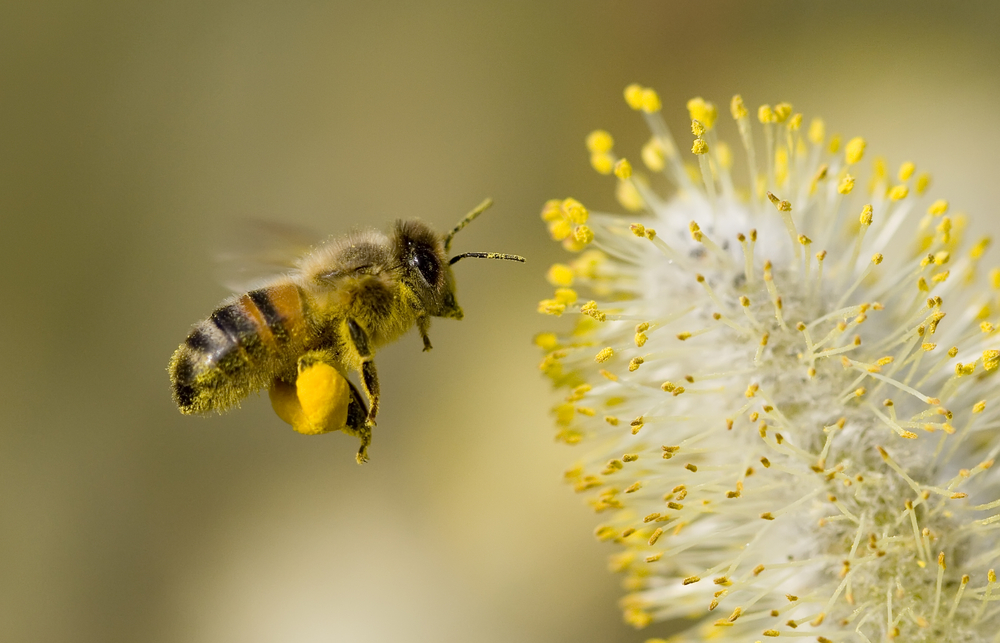
A really bad place, indeed. And not just because we wouldn’t have honey to make all those breakfast cereals or sweet candies. Bees are one of our planet’s primary pollinators, transferring pollen and seeds from flower to flower, fertilizing plants so they can produce fruits and vegetables. In the US alone, honey bees pollinate about $15 billion worth of crops each year, including all kinds of fruits, vegetables, melons and nuts. Every spring, California’s almond growers truck in half of America’s honey bee population to fertilize more than 80% of the world’s almond supply.
Honey bees even have an impact on meats and dairy products, pollinating crops like alfalfa that feed our nation’s cattle.
Concerns about the future of our food system spurred Bonner to start Bee Downtown, a company that creates and sells rooftop and clear storefront observatory hives in urban locations. Despite what you might assume, bees thrive in cities, with downtown hives serving as feeder populations to rural areas, as newborn queens fly off to start colonies elsewhere.
Bees the size of small dogs crawl over a brick wall on the fringe of downtown’s American Tobacco Campus.
Most of them cannot fly – they haven’t had their wings painted on yet.
The bees are the product of muralist Matt Willey’s paintbrush and have been commissioned by Burt’s Bees, whose corporate hive exists just behind the brick.
Willey, 46, a New York City transplant who sleeps in Asheville, has embarked on a bee-themed mural marathon. Willey’s goal is to paint a total of 50,000 honeybees in a series of murals in public spaces across the U.S. and the world.
Why 50,000? According to his website, www.thegoodofthehive.com, the number represents the population of honeybees in a healthy hive.
Bees bigger than bricks command attention, which is Willey’s intention, ever since he first read about declining populations of pollinating bees in the United States.
“I can make them big enough so people can see them more clearly,” he said.
The mural is a nature-scape superimposed over the Lego-like masonry of the American Tobacco architecture. The artwork puts bees and people eye to eye.
On a recent weekday morning downtown, a group of four kids and two moms out on an app-driven geocaching expedition took notice of the mural.
“I like the way that the bees are gathered together,” said Piper Barnes, fifth-grader-to-be. Piper was impressed by how the mural bees reflected the group behavior visible in the bustling “live-hive” of real bees that Burt’s Bees maintains right around the corner from the painting.
Durham recently was certified as a member of Bee City USA, an organization born in Asheville that promotes pollinator-friendly cities.
Paula Alexander, director of sustainable business and innovation at Burt’s Bees, contacted Willey about a mural after his crowdfunding video drew her attention.
“I’ve helped him get through hoops,”Alexander said.
“Every job has a ‘champion,’
” Willey said. “I need someone on the ground to deal with logistics.”
When work on the mural began in late April, Alexander asked Willey whether the 400 employees at Burt’s Bees could help him paint.
“I wasn’t open to the idea,” Willey said, “until I said yes to it.”
Willey and Alexander settled on having each employee, from the general manager on down, paint an individual petal of the flowers that will line the bottom of the mural.
“Once we compartmentalized (the participation), I loved it,” Willey said.
Ansible, a Durham open software automation firm acquired by Red Hat in 2015, made a move this week to broaden its market share through more Bull City innovation.
The company announced the release of what it’s calling “Ansible 2.1,” the latest version of its open source IT automation framework. It’s the third major release since Ansible was acquired by open source giant Red Hat (NYSE: RHT) last October, and another release – this time for its Tower Software – is expected in the coming weeks, says Todd Barr, senior vice president of sales and marketing.
While Ansible’s pace hasn’t picked up when it comes to product launches – (“We’ve never slowed down”) Barr says Red Hat’s resources have been able to broaden each of those releases.
“We’re doing more in the same time cycles, really because we have more people,” he says. While, citing the obligatory pre-earnings quiet period, he says he can’t provide a specific headcount, he says Ansible has increased healthily since it disclosed in March that it had 85 dedicated employees.
And it’s that investment that, so far, has had the most impact on Ansible post-buy. “We now have the ability to hire quality engineers,” Barr says. “When you’re a startup, you’re trying to get to market as fast as possible.”
When you’re Red Hat, a company that just posted $1.72 billion in annual revenue last February, you have the resources to refine further and fully test out your product. And a lot of that is through the people you’re able to higher – both with the Red Hat Wallet and with the Red Hat prestige. “We get a bigger pool of candidates,” he says. “And we’re still adding people in Durham, which is cool.”
Ansible is on track to meet the job projections it had when the deal was first announced, he says.
Last October, company executives said the then-50 person local headcount would likely add up to 50 employees in the 2016 calendar year.